
Anukalp: Four Lines Youth Storytelling
Four Lines: Youth Storytelling Project honors the voices of four youth—Corvine, Anukalp, Wakinyela, and Kimimila—who share personal stories of climate change grounded in reflection, lived experience, and place.
About the Author

Anukalp (he/him, age 13 when this story was written) is an environmental advocate who firmly believes that every small action counts and contributes to a larger movement to combat climate change. He’s dedicated to his cause and actively involved in community initiatives aimed at protecting the environment.
Anukalp's Story Line
“Tiny actions can create strong impacts.”
Author’s Note: “My favorite place to hike has to be Barn Bluff, in Red Wing, which is also the place where my climate story takes place, and the reflections I have had when there. I want Barn Bluff to remain an amazing place for many years to come, allowing ourselves and future generations to enjoy it, too.”
Clarity at the Top (Audio)
Clarity at the Top (Transcript)
Ten steps left, nine steps. You’re almost there.
Eight steps, seven steps. Walk a bit faster.
Six steps, five steps. Don’t give up now.
Four steps, three steps. The end is in sight.
Two steps, one step, stop! The path ends. You’re at the top of the bluff, king of the world, even if it’s just for one moment. Glance down, at the buildings so small, with ants crawling about. Take a look around, do you feel anything?
Smell the Mississippi River, it’s different, don’t you think?
Feel the cool breeze on your skin. Does it sting, or does it soothe?
However, as you stand here, you recall that your journey is not yet over. Focusing on the details of your environment, you can’t help but notice. A large canvas of green and blue is presented before you, stretching as far as you can see. Nevertheless, the longer you look, the more imperfections you spot. A grid of roads streaks it with gray. There are fewer trees than there used to be. The sounds of the outdoors are less prominent than before. What could’ve happened?
The invisible force of destruction.
Overlooked factors, erroneous decision-making, and the need for industry all contributed to working backward to corrupt the masterpiece known as nature. None were purposeful. It all started with small choices and small steps. ‘What’s the worst that could happen?’ some had asked.
Little did they know, their small footprints would soon proliferate until they became almost uncontrollable. There is no one individual to blame, but everyone as a collective group. Your trek is only halfway complete; you need to go back down the slope and return to the world. Still, each descending step feels heavier with the weight of realization. The biosphere around you, which is so often taken for granted, is always being overshadowed by the so-called chaos of everyday life.
Chaos. How can something this large and beautiful be so bluntly ignored? Is this the last you will ever see of a flourishing ecosystem?
The sky is darker than usual. It doesn’t need to be like this. This burden, however immense, is not insurmountable. The power to change it is not as far as it seems. Just as small steps have caused enormous changes, tiny actions can create strong impacts. Taking the time to appreciate nature, using your voice, and making small, mindful choices in your daily life, can help restore that delicate balance and reignite a sense of wonder in the world around you.
Your steps seem lighter. The world seems to brighten around you.
Remember, it’s not over.
It never is.
About the Artwork
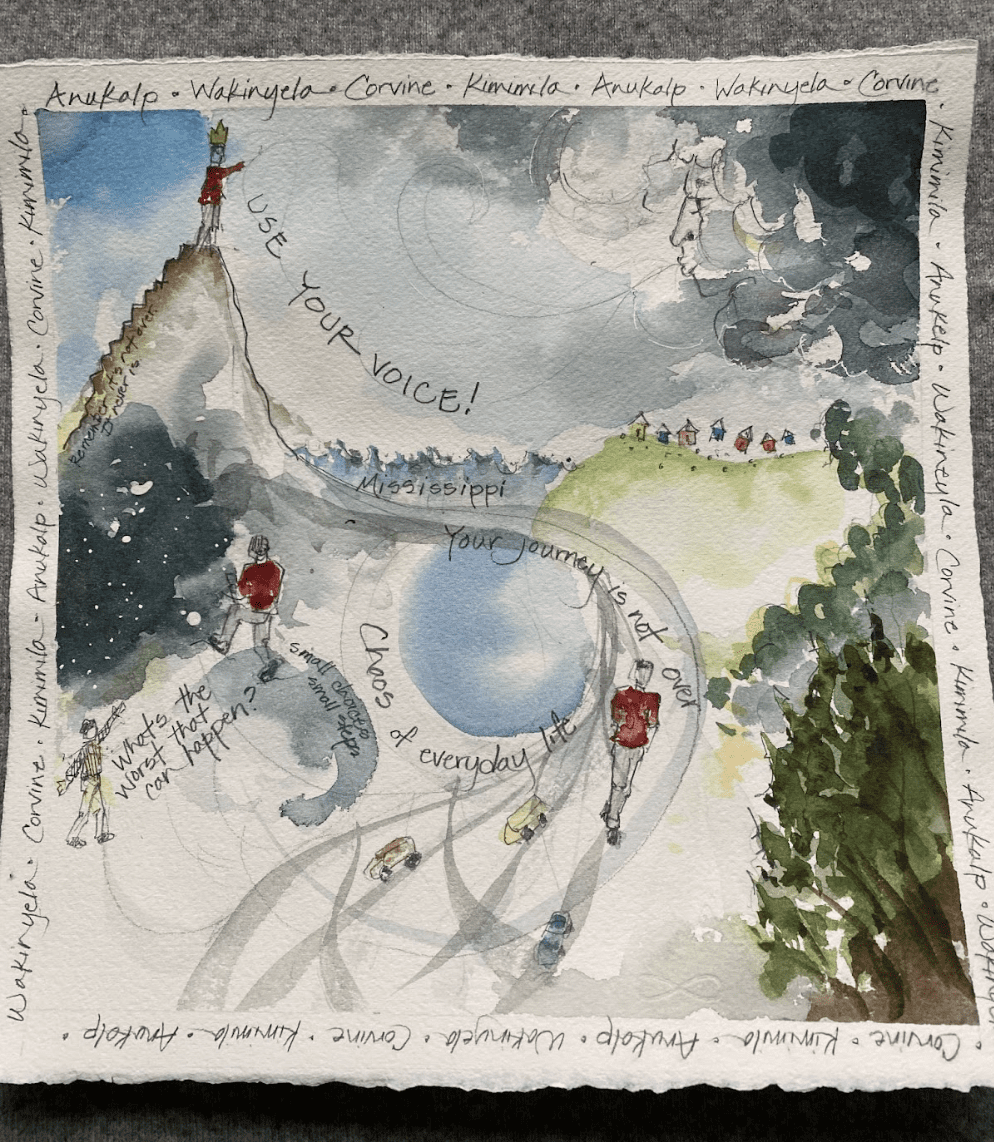
The artist’s sketch depicts the journey of the narrative. The central figure, shown wearing a red shirt, represents Anukalp. In the upper left corner, the opening moment of the story is illustrated: walking up steps and arriving at the top of a bluff, feeling like the “king of the world.” From this vantage point, the figure looks down over the Mississippi River and the small buildings below, while a cool breeze moves across the bluff.
Selected words and lines from the narrative carry the figure forward through the composition—across fields of green and blue, through grids of gray roads, and into the “chaos of everyday life.” In the lower left, another figure calls out, “What’s the worst that can happen?” From there, the main figure takes small, mindful steps through a darkened sky toward a brighter world. The piece concludes with the closing words of the story: “Remember, it’s not over. It never is.”
Anukalp's Call to Action:
I want to preserve our parks and trails, for all of us to do our part to sustain its quality. To remember that “it is not over,” because there are steps we can all take. I would recommend the public to:
- Practice principles of Leave No Trace
- Stick to the trail
- Report anything that might degrade quality
- Educate others about the importance of preservation
- Participate in conservation efforts