
Kimimila: Four Lines Youth Storytelling
Four Lines: Youth Storytelling Project honors the voices of four youth—Corvine, Anukalp, Wakinyela, and Kimimila—who share personal stories of climate change grounded in reflection, lived experience, and place.
About the Author
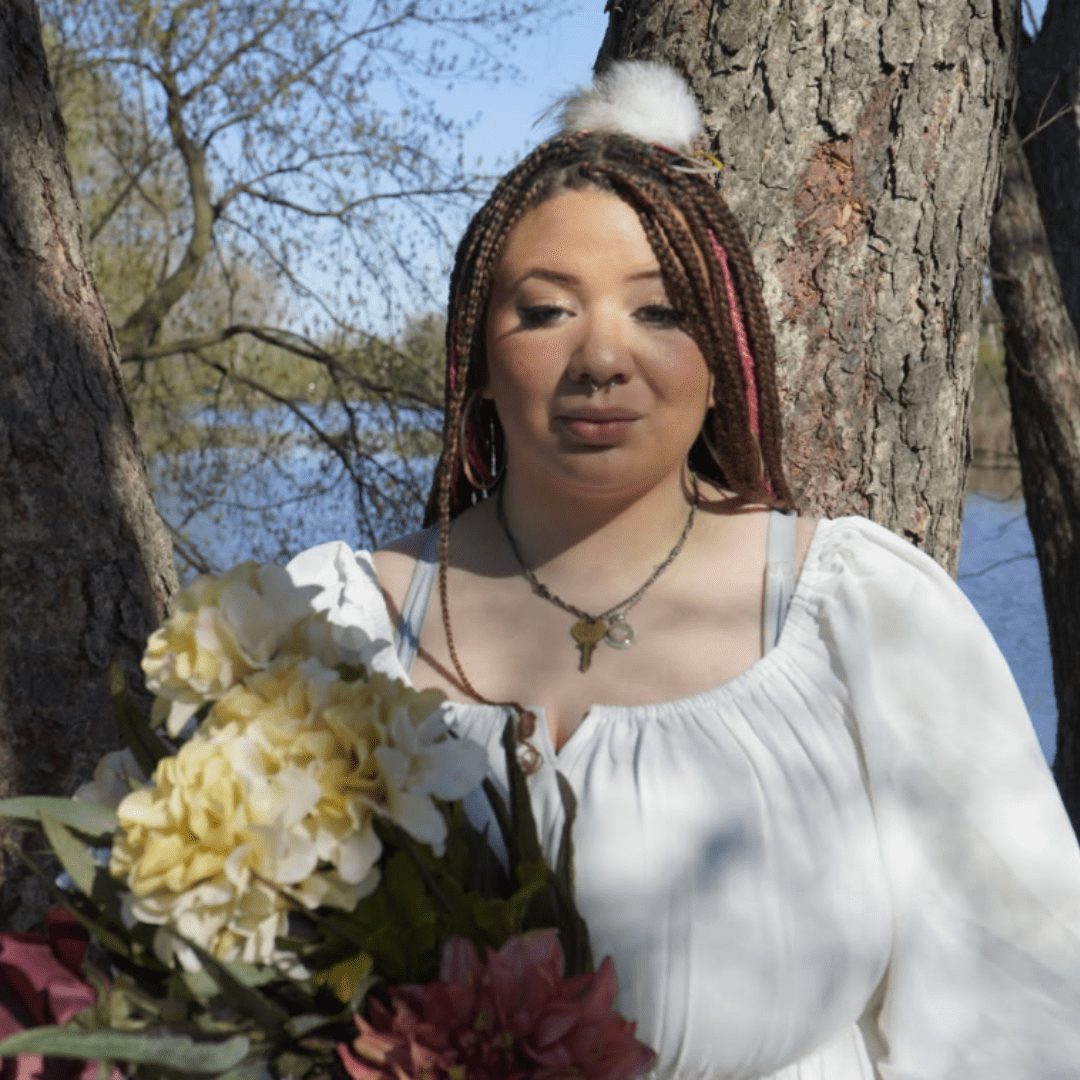
Kimimila (she/her, 17 when this story was written) is a Black, Native, and White American currently studying Statistics and Business in college. Her Native name, Wichápi Kicuwá Win, means “a girl who chases her own star.” Alongside her academic pursuits, she is a political poet whose work includes small published pieces, activist events, and public showcases.
Kimimila's Story Line
“Life’s cycle of beginnings and endings is perpetual.”
Author’s Note: “My climate story relates to how a tornado’s wreckage nature can be seen as an enlightened change to an unmoving routine of a stilled sky, for responsibility in a way is freedom from the cage of consistency that crafts absence in the “why” of a new creation.”
A Tornado's Teachings (Audio)
A Tornado's Teachings (Transcript)
Nature was a short checklist, for it only held one ominous box that my personal pencil of peace relied on. The box’s description: check that the sky was still light, baby, or even powder blue. To indulge in nature’s diminished significance in my adolescence is to begin with the origin of childhood caution, or in rephrase, newborn instinct. The instinct of such new beings is peculiar, as these infants that are surrounded by the world’s doubt and debate in having quickly risen to consciousness know very well when to panic, especially when they feel unfamiliar wrinkled fingers attempt to rock them to sleep. For me, I was born with a warning heart, detecting every heartbeat, unfortunately even my own as a horrendous omen. Though to bring in a fundamental way of word, my origin was attracted to the emotional path of excessive anxiety, earning nicknames like Mama Mia, crybaby, screecher. While the company of rational advice has increased with age, I view fear as a gift of deep comprehension of earth’s capacity to be easily vilified, as it can shake buildings down into graves, burn, leaving the weeping trees at its mercy due to their roots refusing to run, and the great water that is never vacant builds walls of stifled begging breaths. Though the main character of my nightmare lives in whistling winds of apprehension, whispering Lisaphobia raucously in the dark sky. It appears the child of me’s first lesson was to dig myself in the basement of avoidance, so the Tornado’s shovel would not dig me low at a specific measure, perfect for a corpse.
Through early life, I would be haunted by any vague association with the natural disaster, particularly: falling willows, a murder of crows collecting into groups of vigilance, the sound of damning hail, a hollering Wakinya (Thunder), and my check box’s failure: a dark sky. All the reminders made me assume nature had a cult in the upper realm that was pissed at humanity, ready to erratically send out death. Even outside my waking hours, I acquired dreams that would sweep me sweating, but I never died in them, instead a Tornado faced me. It claimed me a coward, in how I never saw it coming.
To change the course of the winds, I shall share a memory that would transform my checklist:
I was once asked a preposterous question in elementary school,
“Would you rather be murdered or die in a natural disaster?” If I recall correctly, everyone’s answer was the first option, including mine. For some reason we found life ending at the hand of another more gentle, even with murder being drenched in more evil intent.
The decision would later sink me into the feeling of stupidity, making me ponder on the why of my fear’s triumph over every other dangerous occurrence. As a Lakota, part of the Sioux Sicungu People, I was taught about the circular motion of life. Not in a shallow sense that we just came back to this exact journey over and over again, but that life’s cycle of beginnings and endings is perpetual because the soul continuously is in the state of learning. This notion is far from astonishing, for our universe is compatible with an infinite function. Through my young desire to be mentally rewired, I gave a guess that earth had a mundane task vs a mission to attack. How? I asked questions. Were the disasters at its hand simply dealing with the refusal of lessons by others? Did the burden of generational mistakes not have the luxury to decompose properly? Tornadoes symbolism matured within me, as a revelation found that they were shaped in circles, identical to the karma of toxic human activities. That while we fear natural events, it is very likely natural events are beyond terrified with our unnatural causes ruining neutrality, or to state, our unnatural disasters.
I think my dynamic with nature truly started with guilt because it made me feel like a past Wasicu, a white man who didn’t think that their ancestors’ mass slaughter, leading to deteriorating preservation of culture and health has anything to do with them. With UnciMaka (nature), I was participating in an audience that was corrupting the earth. The strategy consists of me blaming the past’s generation’s daily activity of throwing McDonald’s plastic cups out the window. I justified that nature didn’t have the right to react within my proximity because my tiny hands compared to callous ones knew where the trash can resided. However, it appears the would you rather question highlighted a clear shame in this ideology, that I was so fearful because I knew I was guilty. Responsibility, responsibility, responsibility must’ve been an unconscious mantra whenever my phobia was stimulated.
What is more interesting than a newborn’s automatic wariness, is how a mere second of empathy evolved my nightmares into curiosity. Additionally, the years were distracted from my evaluation of the sky with every new positive interaction with the leaves and wild beasts, or my father simply teaching me how to bend cedar trees with my back to build a Lakota sweat.
The mistake, the basement of shallow thinking, made me miss that I was a nightmare in the beginning, for I had the power to choose what nature was privileged and discriminated against. That Tunkashila was in the graceful clouds as well in their warping formation. If I had another redo to the prior question, I would pick the second option because humans have the capacity to be the most unnatural thing, for they, WE, are the dark dreams that stand, and hurt just to hurt. There are no spirits for the detrimental system that convinces us to be compliant, an action that should be seen as the scariest of all, just us.
Conclusion: Lisaphobia still knows me well, but climate change has taught me the why and how I need to move forward.
About the Artwork
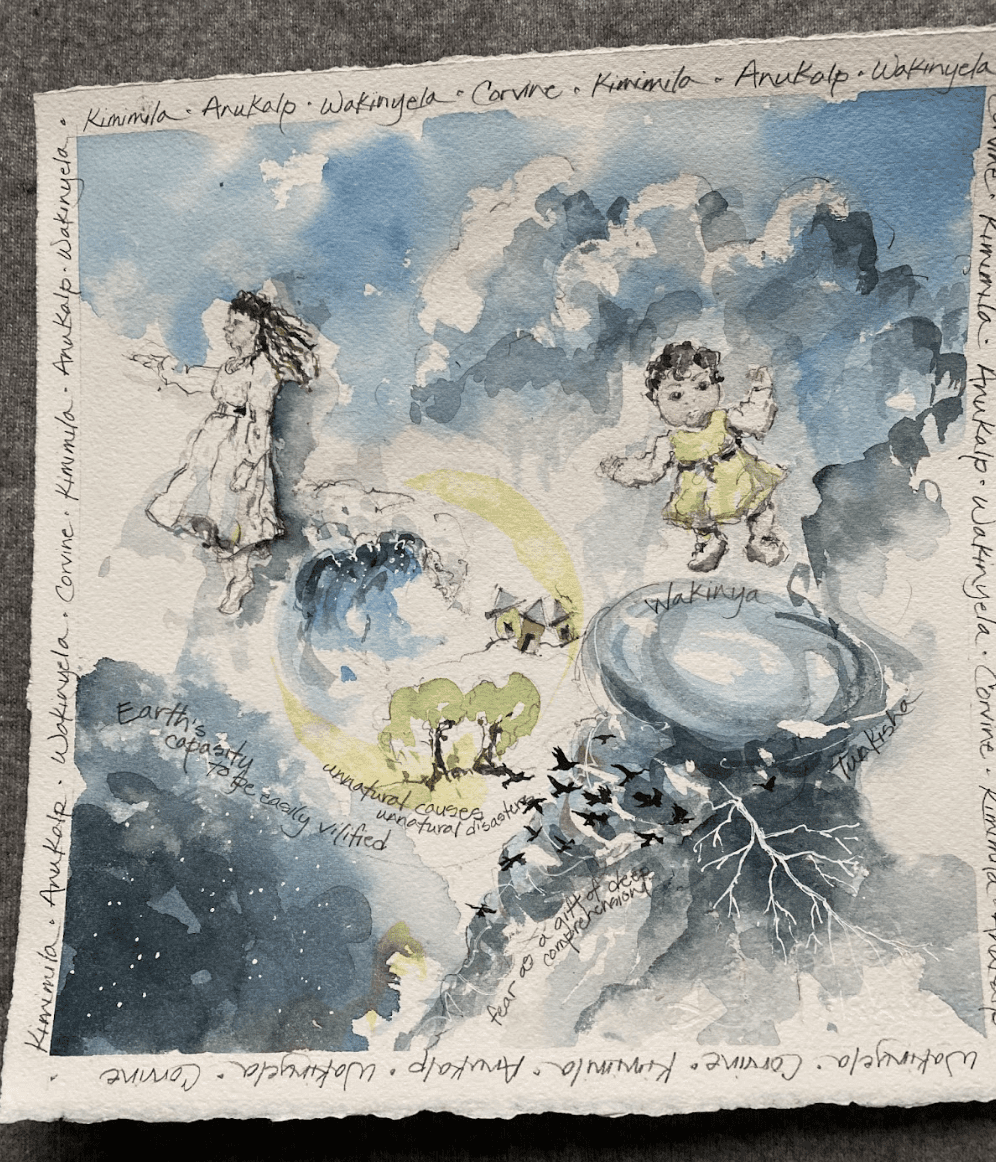
The artist begins in the upper left corner with a sky in soft shades of blue , evoking calm and possibility. Moving across the top, a child represents childhood caution. Wakinya or “Thunder Being” in Lakota floats above in a tornado-like swirl, amidst darkening skies, whistling winds, hail, and a murder of crows, alongside the words: “fear as a gift of deep comprehension…earth’s capacity to be easily vilified.”
The storm sweeps from the lower left corner toward the center, where shaking buildings, weeping trees, and great walls of water appear. The artist uses these elements to show the circular motion of life—from beginnings, represented by the newborn, to endings, illustrated through destruction. Phrases such as “unnatural causes, leading to unnatural disasters” and “Wasicu” referring to settler colonialism underscore themes of human impact and imbalance.
From the center of the storm emerges a figure stepping toward another choice, a path of renewal and engagement with the realities of climate change and possibilities we have in the paths we choose. Kimimila, the storyteller, guides viewers through this narrative, helping us see how the cycle of life, moments of destruction, and the potential for action and transformation are deeply interconnected.
Kimimila's Call to Action:
This story represents the agency we have. Responsibility typically isolates itself to a negative connotation, as it’s utilized with a synonymous parallel to the idea of a burden, however in a society becoming more dripped in nihilism, responsibility produced by consequences reminds us that we matter. Responsibility is another anchor on what our legacy could unravel, and unlike the past, can be sought in a positive manner.